Professional cycling is a sport defined by its relentless climbs, breathtaking scenery, and legendary ascents that test the mettle of every rider. From the snow-capped peaks of the Pyrenees to the fiery slopes of Provence, the most iconic climbing routes have become symbols of human effort, engineering prowess, and indomitable spirit. Each steep gradient, hairpin turn, and stone-paved road carries a story—of victories and defeats, of tenacious teams and solo breakaways, and of the unyielding bond between cyclist and bicycle.
Col du Tourmalet: The Queen of the Pyrenees
The Col du Tourmalet is often hailed as the heritage climb of the Tour de France, with a history stretching back to its first inclusion in 1910. Towering at 2,115 meters above sea level, this formidable pass features two approaches: the eastern side from Sainte-Marie-de-Campan and the western face from Luz-Saint-Sauveur. Both routes present a relentless average gradient of around 8%, punctuated by sections that spike above 10% for several hundred meters.
- Average gradient: 8%
- Length: 17.2 km (east), 19 km (west)
- Elevation gain: 1,404 m (east), 1,404 m (west)
Racers remember the Tourmalet not just for its steep hairpins but for the deafening cheers of the local fans, the swirling mists that obscure visibility, and the iconic yellow jersey often won or defended on its slopes. Its cobbled summit offers a dramatic backdrop for photo finishes, while the narrow mountain road demands perfect tactics and positioning within the peloton. Bike manufacturers have long tailored lightweight frames and compact gearing systems specifically for conquering this Pyrenean giant.
Mont Ventoux: The Beast of Provence
Standing alone like a sentinel watching over the Provence landscape, Mont Ventoux is known as the “Giant of Provence.” At 1,909 meters, the climb may not be the highest, but its barren, lunar-like summit and brutal exposure to wind make it one of the toughest tasks in any race. The traditional ascent starts in Bédoin and stretches over 21.5 km, with an unforgiving average gradient of 7.5% and sections reaching 12% near the summit.
- Length: 21.5 km
- Average gradient: 7.5%
- Summit elevation: 1,909 m
The Ventoux has witnessed epic battles, including the tragic 1967 stage where British rider Tom Simpson collapsed. Riders here face not only steep slopes but also swirling mistral winds that can exceed 100 km/h. Teams often equip their climbers with ultra-light carbon frames, disc brakes for precise control, and deep-tread tires for the barren terrain. Modern sports science has also introduced altitude training rigs and detailed wind-resistance simulations to prepare for this challenge.
Stelvio Pass: Italy’s Alpine Marvel
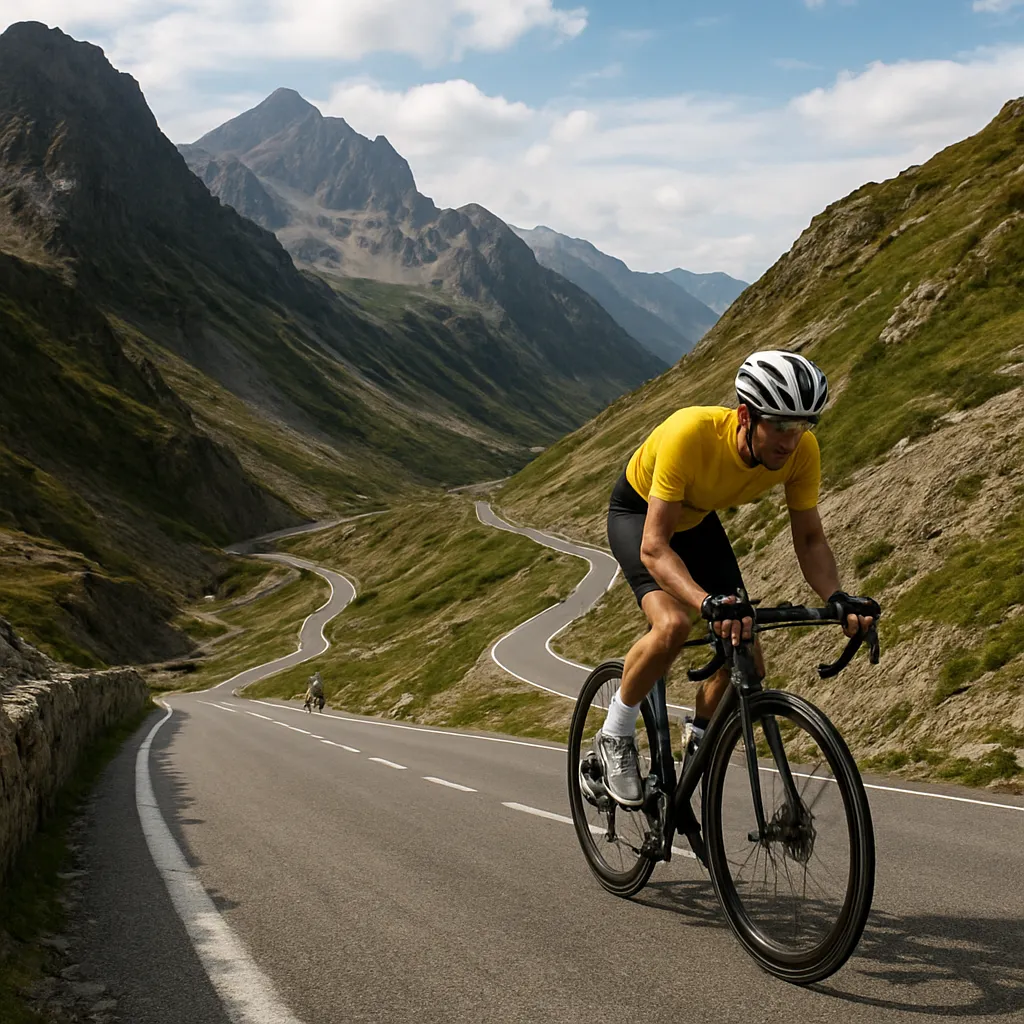
The Stelvio Pass, Italy’s highest paved mountain pass at 2,757 meters, is a staple of the Giro d’Italia. Its north face boasts 48 hairpin bends over 24 km, with an average gradient of 7.4%. Winding through the Ortler Alps, this road offers dramatic drop-offs, snowbanks even in summer, and breathtaking panoramas over alpine peaks.
- Altitude: 2,757 m
- Distance: 24 km
- Hairpins: 48
Many cyclists consider the Stelvio a pilgrimage, seeking to conquer its serpentine ascent and embrace its storied past. In 2013, Chris Froome’s solo breakaway from more than 50 km out, culminating atop the Stelvio, showcased both physical endurance and mental fortitude. The route demands precise gear ratios—often a 34×32 compact chainset—and disc wheels for optimal performance on steep gradients and switchbacks. The combination of altitude, length, and relentless rise makes this climb an unmistakable alpine test.
Alpe d’Huez: The Legend of 21 Hairpins
Known worldwide for its 21 numbered hairpin bends, Alpe d’Huez is the crown jewel of French climbs. At 1,860 meters, this ascent from Bourg d’Oisans stretches 13.8 km with an average gradient of 8.1%. Each bend carries the name of a past Tour stage winner, immortalizing cycling’s greatest heroes.
- Length: 13.8 km
- Average gradient: 8.1%
- Elevation gain: 1,071 m
The steely challenge of Alpe d’Huez has produced unforgettable duels, from Fausto Coppi’s solo breakaways to Marco Pantani’s explosive attacks in 1997. Teams invest in wind-tunnel optimized frames and gear setups with multiple small sprockets to distribute effort evenly across the climb. Fans flock to the slopes, lining the road in a festival of flags and cowbells that echoes for kilometers. This iconic route encapsulates the theatrical spirit of Grand Tour ascents.
Giro’s Mortirolo: The King of Climbs
Often dubbed the most difficult climb in the Giro d’Italia, the Mortirolo Pass rises to 1,852 meters over 12.4 km, averaging a punishing 10.5% gradient, with stretches exceeding 18%. This Via del Mortirolo road tests riders with narrow lanes, uneven surfaces, and relentless steep ramps.
- Length: 12.4 km
- Average gradient: 10.5%
- Maximum gradient: 18%
The ascent has seen legendary moments such as Marco Pantani’s daring solo attacks. Cyclists facing Mortirolo need to carry the lightest possible gear, often sacrificing aerodynamic benefits for ultra-low weight. Custom evolution prototypes—sub-6 kg frames, hollow carbon handlebars, and titanium axles—have emerged to slice every possible gram on such grueling climbs. By the time riders reach the summit, lactic acid floods their muscles, yet the steep gradients make any respite impossible until the pass crest.
Advances in Bicycle Technology for Climbing
Over the decades, bicycle technology has undergone a remarkable transformation to meet the demands of these relentless climbs. Early steel frames have given way to high-modulus carbon fiber, reducing frame weight while maintaining stiffness for efficient power transfer. Compact cranksets and wide-range tactics cassettes allow riders to maintain optimal cadence on steep slopes.
- Carbon fiber frames: Under 800 grams for top-tier models
- Disc brakes: Superior modulation on descents
- Electronic shifting: Precise gear changes under load
- Power meters: Real-time data for pacing
- Narrow tubeless tires: Lower rolling resistance and puncture protection
Innovations such as integrated cockpits, custom wheel profiles, and aerodynamic optimization through computational fluid dynamics (CFD) have further refined climbing machines. Teams engage in meticulous wind-tunnel testing and real-world simulation camps at altitude to evaluate gear combinations, rider-bike interaction, and ergonomics. Nutrition strategies, involving epochal energy gels and electrolyte formulations, ensure that cyclists can tackle over two hours of sustained climbing without bonking.
The Human Element: Endurance, Strategy, and Spirit
While bicycle evolution has reshaped climbing possibilities, the core of every ascent remains the human body and mind. Climbers endure oxygen-deprived conditions, battling cramps, fatigue, and the ever-present risk of mechanical failure. Team directors communicate via race radios, plotting when to send domestiques to the front to set pace, when to launch attacks, and when to conserve energy for the final summit push.
Weather adds another unpredictable dimension: rain-slick roads on Stelvio’s hairpins, searing heat and mistral gusts on Ventoux, ice patches on Mortirolo in springtime recon rides. Mastering these elements demands not only physical preparedness but also unwavering mental focus and split-second tactics. Cycling legends are made on these slopes, their names etched in the annals of sport by victories and valiant losses.
Celebrating the Spirit of Climbing
The most iconic climbing routes in professional cycling embody the essence of the sport: a relentless pursuit of excellence, a deep respect for nature’s grandeur, and an unbreakable bond between rider and machine. Every alpine ascent, every hairpin bend, and every cheering spectator contributes to a tapestry of stories that span generations.
As bicycles continue to advance and the margins between victory and defeat shrink, these legendary climbs remain an enduring testament to human capability. Whether you’re a fan, a weekend warrior, or a professional competitor, the call of these towering summits represents a timeless invitation to push beyond limits and embrace the true spirit of cycling.